8:44in productionCh. 1 · Before chillies, there was salt and time/ 8:44 · ceiling 15 min
Food
Kimchi
Kimchi is older than chillies — and that changes everything about how we read tradition.
Kimchi is a fermented vegetable side dish from Korea, with roots in the Three Kingdoms period. It predates chillies by over 1,000 years. Its method relies on spontaneous lactic acid fermentation. It became widespread under Silla Buddhism and remained radish-based through Goryeo. Chillies arrived only after 1614. Its modern spiciness is a relatively recent adaptation — not an origin.
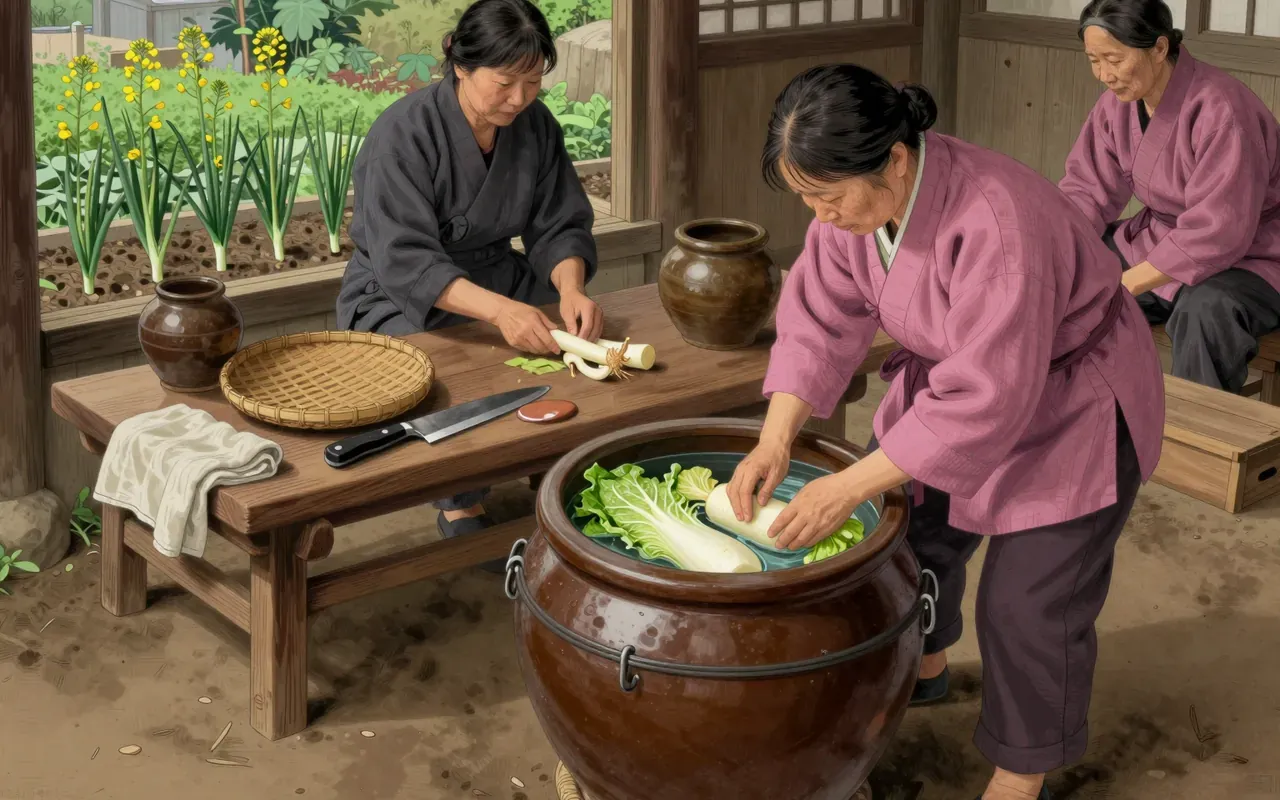
Fermented vegetables were eaten across Korea’s Three Kingdoms — not as novelty, but as necessity.
2:09
A Buddhist side dish
Buddhism in Silla made kimchi a dietary anchor for vegetarian practice.
3:28
White kimchi, not red
Radish kimchi was already common in Goryeo — centuries before red pepper paste.
5:05
The accidental spice
Chili peppers entered Korea after 1614 — and only later became standard.
Worth your time?
Yes. Study the whole thing.
4.5/ 5
What works
preservation
seasonal adaptation
microbial literacy
What does not
influence
define
start
displace
Study it if
Korean households
seasonal cooks
vegetarian practitioners in pre-modern Korea
Skip it if
chilli-first food historians
modern fusion chefs ignoring chronology
The written brief1 min read
What the thing is
Kimchi is a family of Korean fermented vegetable side dishes, traditionally made without starter cultures and driven by spontaneous lactic acid fermentation.
Where it came from
It emerged during the Three Kingdoms period (57 BCE–CE 935), with documented use in Goguryeo, Silla, and Goryeo — long before chili peppers arrived.
What it gets right
It preserves vegetables year-round using only salt, time, and native microbes. It reflects seasonal rhythms and regional variation without industrial intervention.
What it gets wrong
It is routinely misrepresented as inherently spicy. Chili peppers were absent for over a millennium — the modern version is post-1614.
Why it matters now
It challenges assumptions about ‘traditional’ food by revealing how deeply colonial trade routes (e.g., Portuguese introduction of chilies) reshaped even the most local practices.
Is it worth your time
Yes — if you want to understand how fermentation shaped Korean daily life, not just cuisine.