culturebriefs
8:33in productionCh. 1 · Origin is linguistic and territorial/ 8:33 · ceiling 15 min
Food

Fufu

Fufu isn’t comfort food—it’s a living archive of resistance, adaptation, and uncredited labour.

Fufu is a West African pounded starch with origins among the Akan peoples of Ghana. It predates cassava, which arrived from Brazil in the 16th century. Preparation varies sharply by region—pounded in Ghana, fermented in Nigeria—making it a marker of local knowledge, not a monolithic tradition.

Chapters & takeaways4
  1. 1:16
    Origin is linguistic and territorial

    The word and the food both begin with the Akan people of Ghana—not as a generic 'African staple', but as a specific cultural technology.

  2. 2:42
    Cassava was an addition, not a foundation

    Cassava didn’t replace fufu—it reconfigured it. The 16th-century introduction changed the texture, shelf life, and labour of the food, but not its function.

  3. 4:07
    Method defines region, not recipe

    Ghana pounds; Nigeria ferments. These are not ‘versions’—they are divergent technical lineages rooted in soil, climate, and social organisation.

  4. 5:12
    It only exists in relation

    Fufu is never served alone. Its existence depends on what it carries: soup, stew, context. It refuses autonomy.

Worth your time?

Yes. Study the whole thing.

4.5/ 5
What works
  • as a lens on agricultural change
  • as evidence of unbroken technical transmission
  • as resistance to homogenisation
What does not
  • iconic
  • groundbreaking
  • timeless
Study it if
  • people studying food as cultural infrastructure
  • readers tracking postcolonial material continuity
  • cooks who treat technique as history
Skip it if
  • those seeking culinary novelty or fusion trends
  • readers looking for celebrity chef endorsements
  • anyone expecting a unified 'African cuisine'
The written brief1 min read

What the thing is

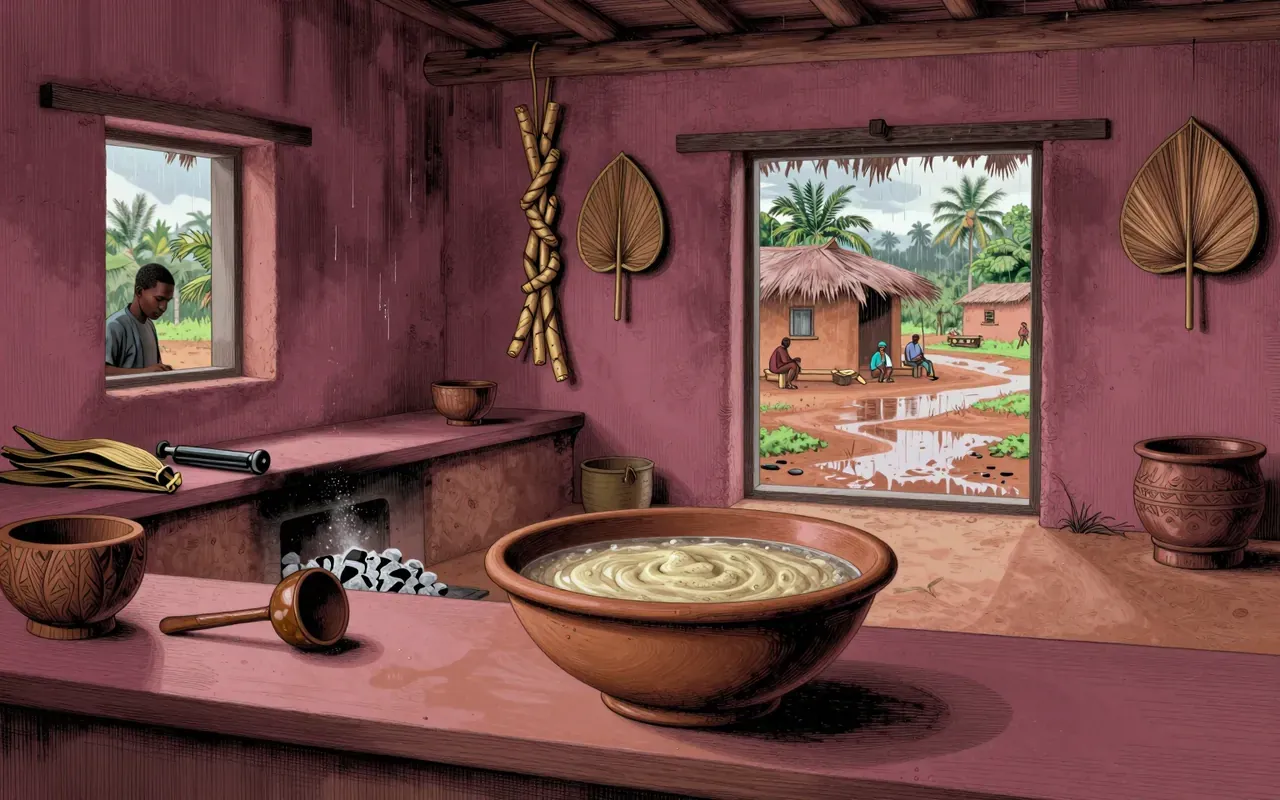
Fufu is a pounded starchy dough. It is not a dish but a vehicle: a neutral, viscous base for soups and stews. It is defined by method—pounding or fermenting—not by taste or garnish.

Where it came from

It originated among Akan peoples in modern-day Ghana—the Asante, Akuapem, Akyem, Bono, and Fante—where it was made from boiled cocoyam, plantain, and yams before cassava arrived from Brazil via Portuguese traders in the 16th century.

What it gets right

It establishes food as infrastructure. Its preparation demands collaboration, rhythm, and embodied knowledge. Its variations map linguistic, ecological, and historical boundaries precisely.

What it gets wrong

It does not resolve the erasure of pre-cassava tuber hierarchies. Cocoyam, plantain, and yam were not interchangeable substitutes—they carried distinct agricultural, ritual, and nutritional roles now flattened under the ‘fufu’ label.

Why it matters now

Because its persistence across West Africa and the Caribbean reveals how culinary practice outlives borders, survives translation, and resists standardisation—even as global food systems erase the very tubers that first made it possible.

Is it worth your time

Yes—if you want to understand how a single food encodes regional sovereignty, colonial rupture, and diasporic continuity without fanfare or explanation.
Same beat · Food4 of 210
Up next in Culture

Fugu

· 9:15

Fugu isn’t dangerous because it’s wild—it’s dangerous because we let it eat the wrong things.

9:15