9:25in productionCh. 1 · What it is/ 9:25 · ceiling 15 min
Food
Enchilada
Enchiladas aren’t ancient tradition—they’re a 19th-century archive of survival, translation, and erasure.
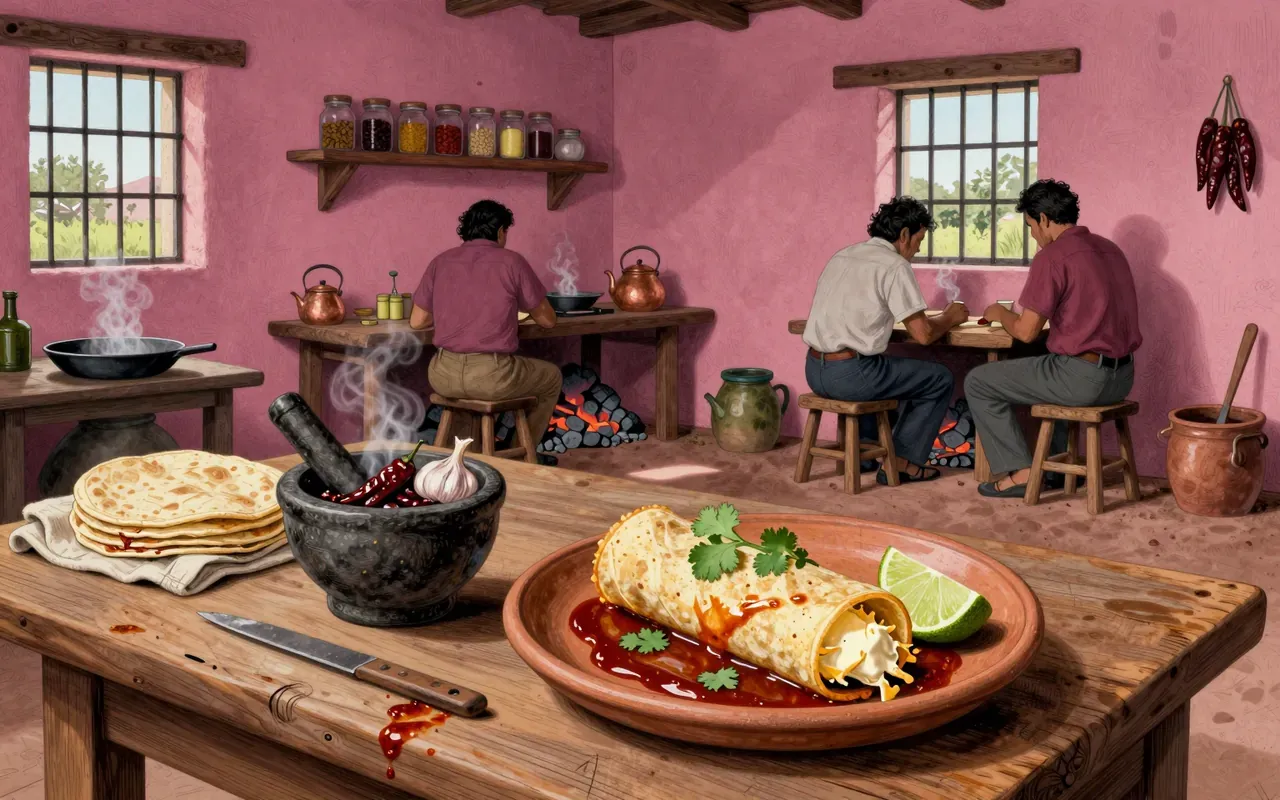
Enchiladas are a Mexican dish. They originated in Mexico. The practice of rolling tortillas around food dates back thousands of years. People in the lake region of the Valley of Mexico ate corn tortillas rolled around small fish. A feast hosted by Hernán Cortés in Coyoacán included foods served in corn tortillas. The Nahuatl word for enchilada is chīllapītzalli. Enchiladas were mentioned in El cocinero mexicano in 1831. Enchiladas were mentioned in Diccionario de Cocina in 1845.
Enchiladas are defined by structure: corn tortilla, filling, sauce—and they are Mexican by origin and name.
2:32
Where it came from
Rolling tortillas around food began thousands of years ago in the Valley of Mexico—and the Nahuatl word chīllapītzalli proves its pre-Hispanic linguistic life.
3:58
How it was codified
Enchiladas entered the written record not as folklore but as national cuisine—in two Mexican books published in 1831 and 1845.
5:37
When outsiders saw it
A Spanish conquistador’s feast in Coyoacán in the 1520s is the earliest documented European encounter with tortilla-wrapped food—but not with ‘enchiladas’ as defined today.
Worth your time?
Yes. Study the whole thing.
4/ 5
What works
El cocinero mexicano (1831)
Diccionario de Cocina (1845)
What does not
culture/art
culture/arts
culture/cities
culture/fashion
Study it if
people who study how food becomes official
readers tracking colonial erasure in culinary language
cooks questioning authenticity claims
Skip it if
those seeking cooking tips
fans of Tex-Mex adaptations
viewers looking for restaurant recommendations
The written brief1 min read
What the thing is
An enchilada is a corn tortilla rolled around a filling and covered with a savory sauce.
Where it came from
It originated in Mexico. The practice of rolling tortillas around food dates back thousands of years in the lake region of the Valley of Mexico, where people rolled them around small fish. The Nahuatl word chīllapītzalli confirms indigenous linguistic roots. Formal references appear in 1831 and 1845 Mexican publications.
What it gets right
It establishes corn tortillas as the structural core. It anchors the dish in the Valley of Mexico’s lake region. It names the Nahuatl origin chīllapītzalli. It cites two 19th-century Mexican texts that formalised it as cuisine.
What it gets wrong
It implies continuity from pre-Hispanic fish rolls to modern enchiladas without evidence of unbroken practice. It treats ‘enchilada’ as a stable category across millennia, though the document shows only that rolling tortillas around food is ancient—not that the sauce-covered, filled form existed before colonial contact or 19th-century codification.
Why it matters now
It reveals how colonial documentation (Cortés’s feast) and national codification (El cocinero mexicano) shaped what counts as ‘authentic’ Mexican food—displacing oral, regional, and unrecorded variations while elevating certain forms into official cuisine.
Is it worth your time
Yes—if you want to understand how a simple, ancient food practice became a vessel for regional identity, colonial encounter, and culinary documentation.