culturebriefs
8:48in productionCh. 1 · The template is a UI/ 8:48 · ceiling 15 min
Subcultures · Society

Image macro

It wasn’t funny—it was functional: the first universal interface for internet speech.

Image macros are a digital interface—not an art form. They standardised how millions expressed irony, frustration and affiliation before platforms automated tone and stripped away authorship. Their rigidity enabled scale. Their simplicity enabled theft. Their legacy isn’t humour—it’s the template as infrastructure.

Chapters & takeaways4
  1. 1:01
    The template is a UI

    Text placement and font are not stylistic choices—they’re interface constraints baked into the format.

  2. 2:27
    Lolcats broke the gate

    Lolcats didn’t start a trend—they proved the template could travel beyond niche forums.

  3. 3:55
    It became a language

    Advice animals and rage faces turned the template into a grammar—with subjects, verbs, and punchlines.

  4. 5:23
    Not all macros are jokes

    Humour was optional. Witty messages and catchphrases were the real payload.

Worth your time?

Yes. Study the whole thing.

4/ 5
What works
  • as a communication protocol
  • as a historical marker of pre-algorithmic internet participation
What does not
  • it is not a movement
  • it is not a genre
  • it is not a platform
Study it if
  • anyone who studies how meaning travels online
Skip it if
  • those seeking aesthetic innovation or narrative depth
The written brief1 min read

What the thing is

An image macro is a digital image overlaid with text—typically large, uppercase, centered, in the Impact font, with a black border—placed at the top and bottom.

Where it came from

It originated on the Something Awful forums, where forum software macros expanded short text inputs into image code. Lolcats were the first notable instance.

What it gets right

It delivers instant legibility. The Impact font, uppercase, black border, top-and-bottom placement, and stock images create a rigid, reproducible frame for cultural shorthand.

What it gets wrong

It flattens tone and context. The format assumes shared reference points and punishes nuance—making irony indistinguishable from sincerity and satire from surrender.

Why it matters now

It was the first widely adopted template for participatory meaning-making online—a precursor to algorithmic virality, not its opposite.

Is it worth your time

Yes—if you need to understand how internet-native syntax shaped mass digital communication before algorithms buried it in feeds.
Same beat · Subcultures4 of 96
10:01
BreakdancingBreakdancing is a street dance style developed by African Americans and Puerto Ricans in the Bronx during the 1970s and early 1980s. It consists of four core movement types — toprock, footwork, power moves, and freezes — performed to music featuring drum breaks. Its Olympic debut in Paris 2024 formalised a global practice that began as an act of cultural assertion in marginalised communities.
9:42
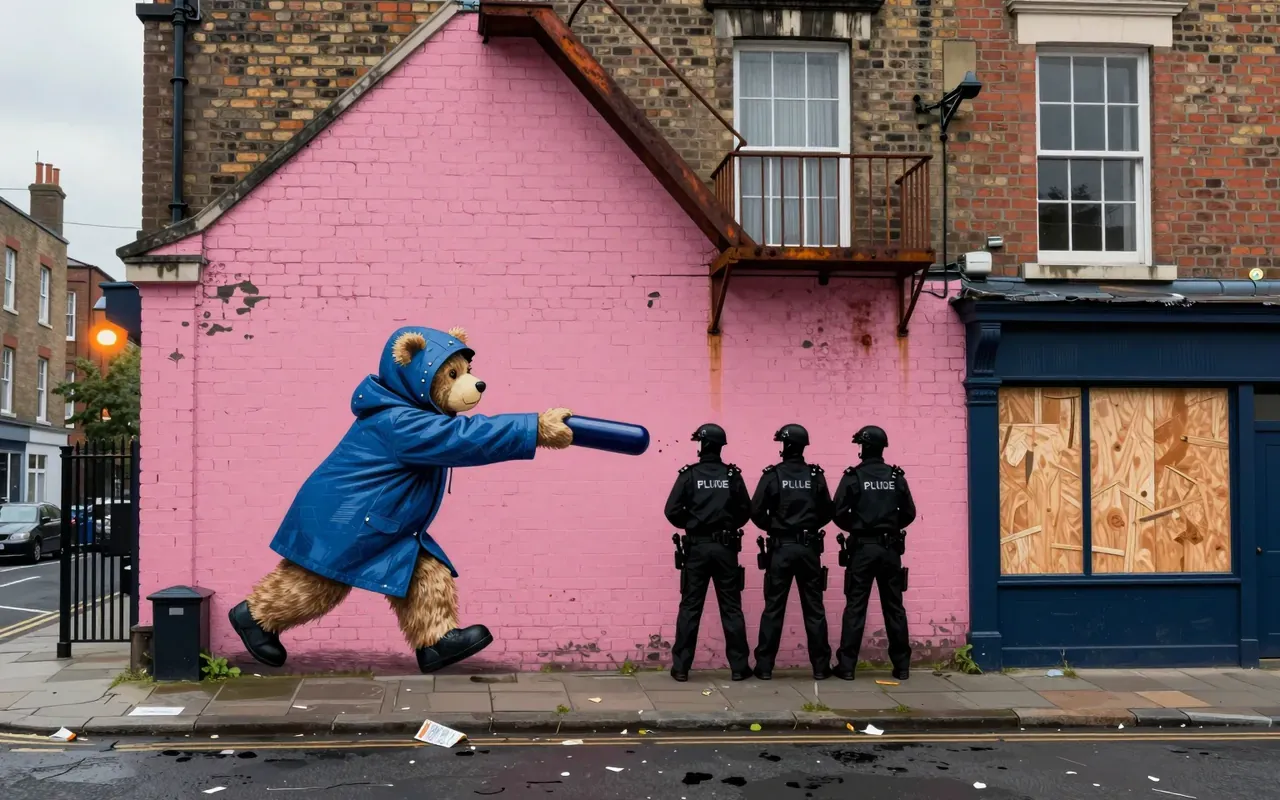
BanksyBanksy is a pseudonymous England-based street artist whose practice centres on stencilled, satirical interventions placed on publicly visible surfaces. He emerged from the Bristol underground scene in the 1990s. His first known large-scale mural was The Mild Mild West in 1997 on Stokes Croft. Banksy makes satire legible on city walls. His stencils deliver punchlines fast. They occupy surfaces people pass daily. They force confrontation without requiring attention. The method relies on evasion—but that evasion obscures authorship, dilutes accountability, and turns political gesture into branded ambiguity. His work established a template for art that operates outside institutions but trades on their validation—exposing the friction between subversion and market absorption.
9:46
BeatnikBeatnik was a media slur—not a self-chosen identity. It erased Kerouac’s spiritually grounded 'beat' in favour of a consumable caricature. Its legacy is not influence, but warning: how fast serious ideas become costumes.
9:30
Camp (style)Camp is an aesthetic sensibility rooted in artifice, affectation, and exaggeration—with playful or ironic intent. It emerged in British theatre from at least the 16th century, gained definable modern usage from the late 17th century, and was codified mid-20th century by Sontag, Isherwood, and Meyer. It disrupts modernist hierarchies of taste. It distinguishes itself from kitsch through self-awareness. It is historically tied to queer identity—especially gay male culture—and defined by Moe Meyer as 'queer parody'. Jack Babuscio identifies its frequent misuse to signify triviality and superficiality. David Carrier observes its subversive and political character.
Up next in Culture

Anonymous (hacker group)

2003 · 8:40

Anonymous isn’t a group—it’s a permission slip to act without accountability.

8:40