8:25in productionCh. 1 · Where it started/ 8:25 · ceiling 15 min
Subcultures · Movements & scenes
Grunge
1985
Grunge wasn’t invented in Seattle—it was named there after the fact, then sold everywhere else.
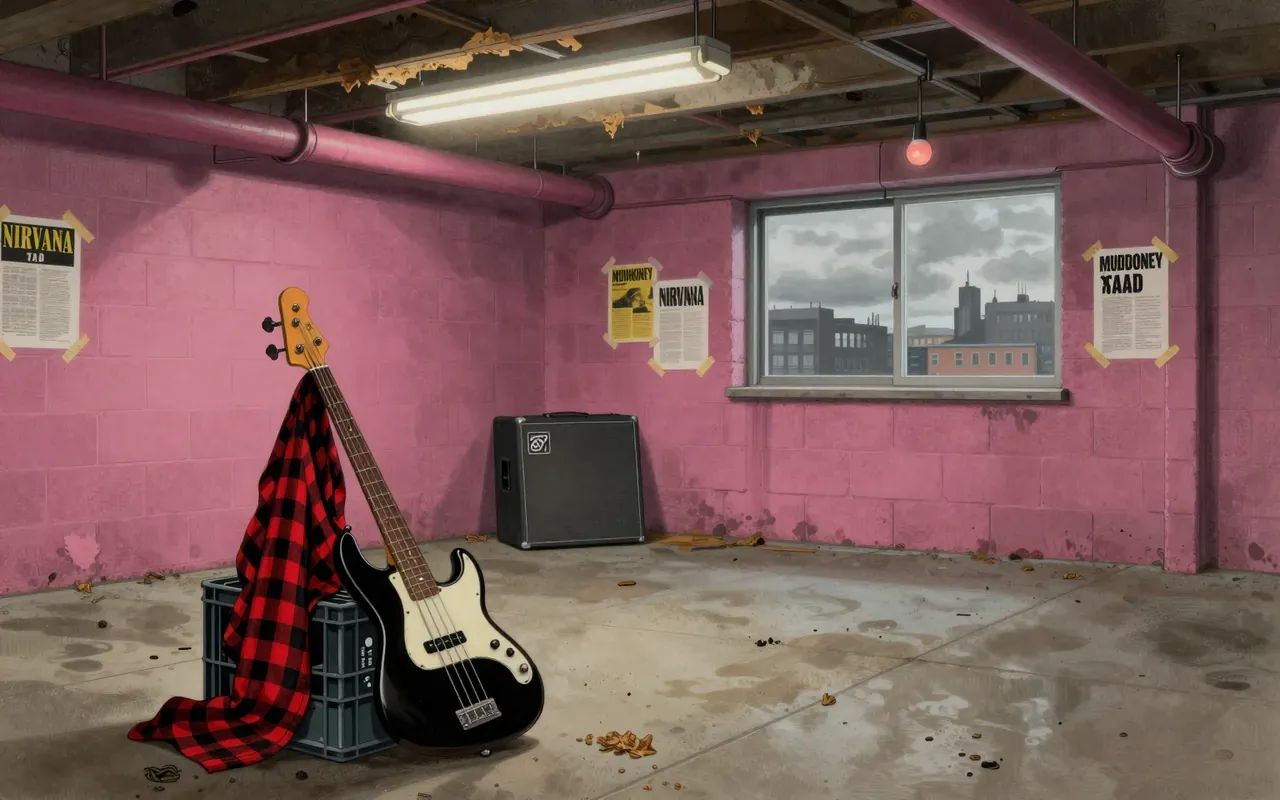
Grunge is a regional rock subculture that originated in the mid-1980s in Seattle and Olympia, Washington, among bands like Green River, the Melvins and Mudhoney. It was not a self-defined movement. It gained national attention only in the early-to-mid-1990s. Its legacy lies less in musical innovation than in how a local scene was repackaged for mass consumption.
Grunge began in two cities: Seattle and Olympia, Washington.
2:23
Who made it first
Green River, the Melvins and Mudhoney were the first bands associated with grunge—in the mid-1980s.
3:32
A regional sound
It was a Pacific Northwest phenomenon—not a national or generational one at origin.
5:07
When it broke
It entered the mainstream only in the early-to-mid-1990s—years after its local emergence.
Worth your time?
Yes. Study the whole thing.
3.5/ 5
What works
as a geographic marker
as a historical reference point for indie-to-mainstream transitions
What does not
influence
define
start
represent
Study it if
regional musicians
Pacific Northwest audiences
independent record labels
Skip it if
national radio programmers
fashion designers
teenagers outside the US
The written brief1 min read
What the thing is
Grunge is an alternative rock genre and subculture. It is not a manifesto or ideology. It is a descriptor for a set of overlapping sounds, styles and scenes centred on Seattle and Olympia.
Where it came from
It emerged in the mid-1980s in Washington state—specifically Seattle and Olympia—among local bands including Green River, the Melvins and Mudhoney.
What it gets right
It names a real place-based convergence of bands, aesthetics and attitudes in the Pacific Northwest. It correctly identifies Green River, the Melvins and Mudhoney as origin points.
What it gets wrong
It implies coherence where there was friction. Grunge was never a unified movement. The label was applied after the fact, not adopted by the bands themselves at the start.
Why it matters now
It matters now because it shows how regional underground scenes can be flattened into global trends—and how quickly authenticity gets outsourced to marketing once mainstream attention arrives.
Is it worth your time
Yes—if you want to understand how a regional, DIY rock scene became a global cultural shorthand. It is not worth your time as a musical primer: the sound was already evolving before it broke through.