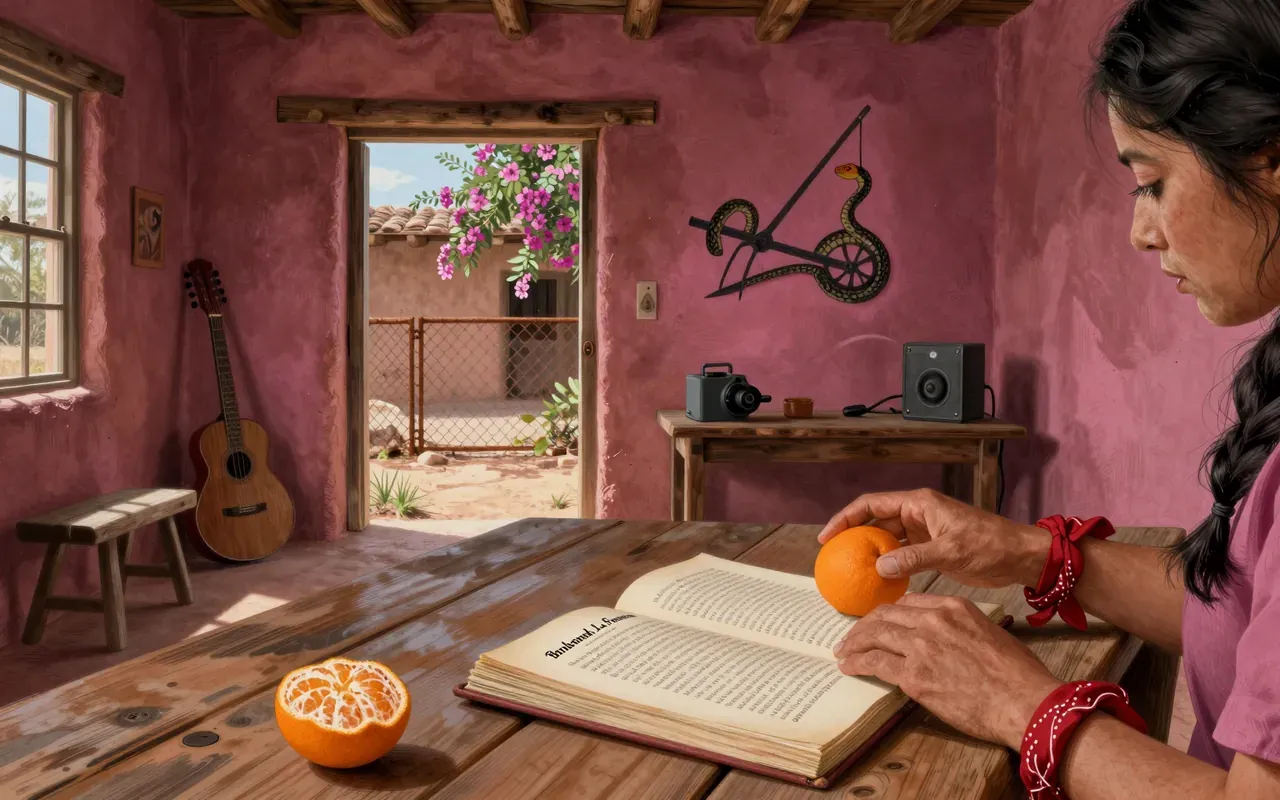
She made bilingual readers feel the sting of monolingual power—and refused to soften it for them.
Gloria Anzaldúa’s Borderlands/La Frontera (1987) is a foundational text in Chicana feminist theory. It grounds theory in personal history, uses multilingualism as political method, and names borderland consciousness with terms like Nepantla and the new mestiza. It does not claim universality. It does not offer solutions. It insists on the legitimacy of mixed speech, mixed ancestry, and mixed belonging—while leaving contradictions unresolved.
Borderlands/La Frontera is theory rooted in lived displacement—not detached speculation.
1:59
Language as Fence
Her multilingualism isn’t decorative—it’s a barrier designed to replicate childhood frustration.
3:32
Land Lost Twice
Her family’s fall from landowners to migrant labourers was caused by racism, tax policy, and carelessness—not fate.
4:43
Claim Without Identity
She named Nepantla and the new mestiza—but rejected 'india' while claiming Indigenous ancestry.
Worth your time?
Yes. Study the whole thing.
4.5/ 5
What works
Borderlands/La Frontera: The New Mestiza (1987)
What does not
culture/arts
culture/cities
culture/fashion
culture/food
Study it if
readers who work across languages
teachers of decolonial literature
people displaced by borders or bureaucracy
Skip it if
those seeking consensus or resolution
readers who expect historical context beyond what Anzaldúa provides
those who require clear authorial stance on Indigenous identity
The written brief1 min read
What the thing is
Borderlands/La Frontera is a theoretical memoir. It is not a manifesto, not a history, not a policy proposal. It is a multilingual, genre-blending record of consciousness formed under erasure.
Where it came from
It came from South Texas: from Anzaldúa’s childhood on the Mexico–Texas border, her family’s dispossession, and her lifelong experience of social and cultural marginalisation.
What it gets right
Anzaldúa names the psychic terrain of borderland marginalisation with precision. She locates oppression in land loss, language policing, and gender dualism—not as abstract forces but as inherited, embodied conditions.
What it gets wrong
She does not resolve the tension between claiming Indigenous ancestry and refusing the identity ‘india’. The document offers no reckoning with that gap—only assertion.
Why it matters now
Because linguistic gatekeeping, border enforcement, and binary thinking have hardened—not softened—since 1987. Her refusal to translate herself remains a tactical provocation, not just a stylistic choice.
Is it worth your time
Yes—if you need tools to name the friction of living between languages, borders, and binaries.