What the thing is
Microbial food cultures are live bacteria, yeasts or moulds. They carry out the fermentation process in foodstuffs.
They fall into three major groups: bacteria, yeasts and moulds. Bacterial cultures divide into starter cultures, which have mainly a technological function in manufacturing, and probiotics, which have a functional role, the ability to confer health benefits to the consumer. The most important bacteria in food manufacturing are Lactobacillus species, in the group of lactic acid bacteria.
Where it came from
They evolved more than three billion years ago. Humans used them in food production since the Neolithic period, around 10,000 years BCE. The scientific rationale for what microbes do in fermentation began to be built with the discoveries of Louis Pasteur in the second half of the 19th century.
A few milestones mark the science. In 1665 Robert Hooke and Antoni van Leeuwenhoek first observed and described microorganisms, and from 1857 to 1876 Pasteur proved the function of microorganisms in lactic and alcoholic fermentation. In 1881 Emil Christian Hansen isolated Saccharomyces carlsbergensis, a pure yeast culture now widely used to brew lager. Between 1889 and 1896 Herbert William Conn, Vilhelm Storch and Hermann Weigmann showed that bacteria acidify milk and cream, and in 1919 Sigurd Orla-Jensen classified lactic acid bacteria by their physiological response patterns. From the 1970s the first industrial concentrated cultures, frozen or freeze-dried, were produced for direct inoculation of processed milk, which improved the regularity of production.
What it gets right
It preserves perishable foods. It improves nutritional and organoleptic qualities. It has sustained human diets for ten millennia. More than 260 different species of microbial food culture have been identified and described for their beneficial use in fermented food products worldwide.
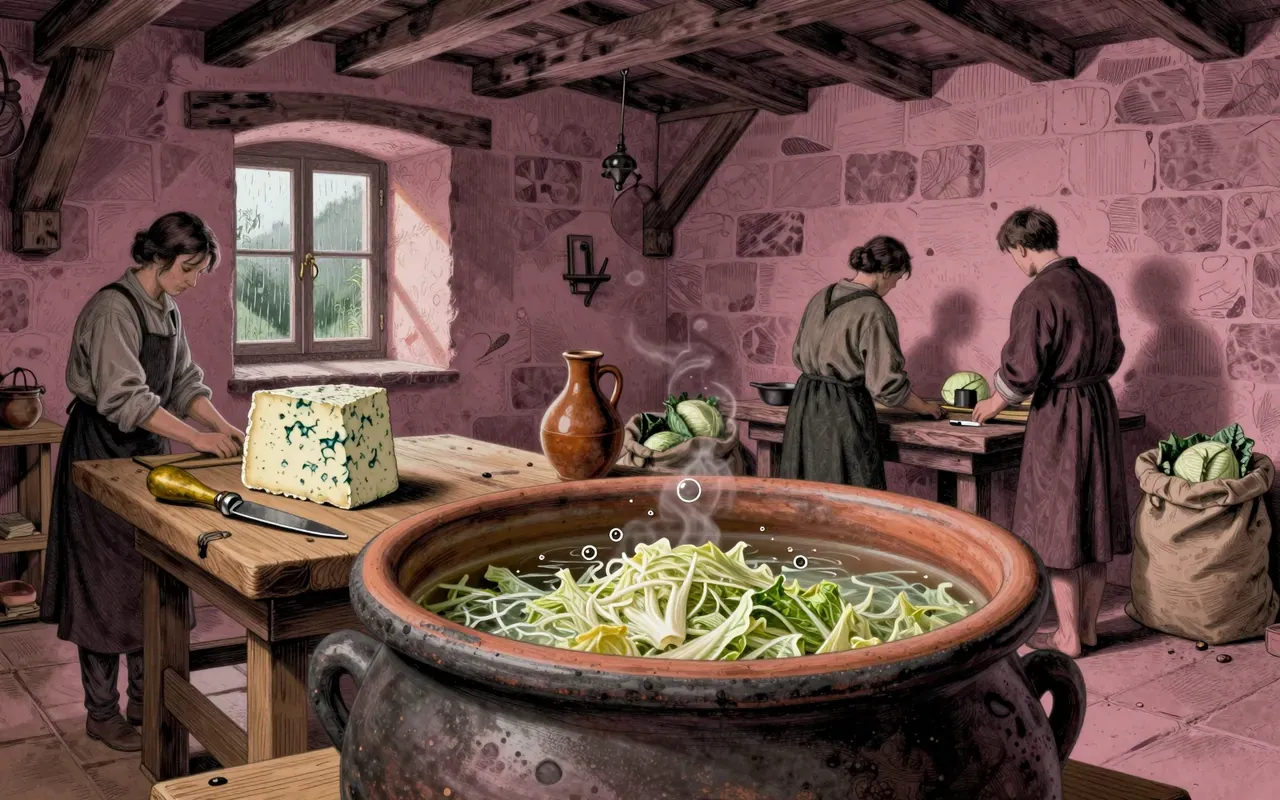
They preserve food through inhibitory metabolites such as lactic, acetic, formic and propionic acid, ethanol and bacteriocins, often combined with lower water activity from drying or salt, and they improve food safety by inhibiting pathogens or removing toxic compounds. Bacteria shape the aroma, taste and texture of cheeses and of fermented milks such as yogurt, ayran, doogh, skyr and ymer. Saccharomyces cerevisiae makes bread rise by producing carbon dioxide in the dough. Three main types of cheese rely on moulds: blue cheese, soft ripened cheese such as camembert and brie, and rind-washed cheese such as époisses and taleggio.
What it gets wrong
Nothing is stated as wrong. The material presents no failures, controversies, risks or limitations.
Traditional fermentation has one limit. Spontaneous fermentation starts from raw milk or from reusing a fraction of the previous production, called back-slopping, and the resulting cultures are complex and extremely variable. The practice is steadily decreasing in developed countries, and some countries prohibit back-slopping because of its “potential to magnify pathogen loads to very dangerous levels”.
Why it matters now
Fermented food still makes up between one quarter and one third of food consumed in Central Europe—as of 1995—and scientific study of these cultures continues taxonomically, physiologically, biochemically and genetically.
The aim is better understanding and improvement of traditional food processing, and the work opens new fields of application.
Is it worth your time
Yes—if you care how food is made, preserved or transformed without refrigeration or additives.